

Latest news
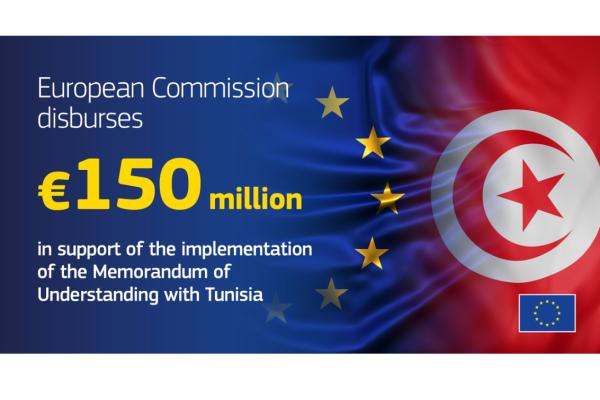
L'Union européenne poursuit son engagement auprès de la Tunisie à travers le déboursement d'un soutien financier sous forme d'appui budgétaire d'une valeur de 150 millions d'euros au profit de la Tunisie…
Today is a very special day. The European Council re-confirmed Europe's unwavering commitment to stand with Ukraine. We all know that Ukraine is fighting for us. So we will support them with the necessary funding and provide them with the much-needed predictability they deserve.
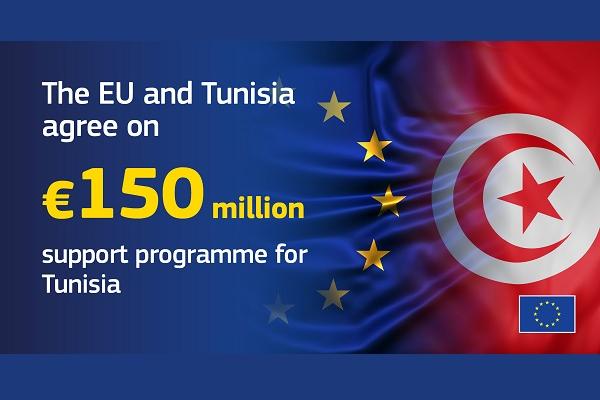
Ce programme de 150 millions d'euros a pour objectif d'appuyer les efforts engagés par le gouvernement tunisien pour favoriser la relance de l'économie à travers, notamment, l'amélioration de la gestion des finances publiques et du climat des affaires et des investissements.
In support of the implementation of the Memorandum of Understanding (MoU) on a strategic and comprehensive partnership between the EU and Tunisia, the Commission is today announcing €60 million in budget support for Tunisia and an operational assistance package on migration worth around €67 millio…
EU and Tunisia
The partnership between Tunisia and the European Union (EU) is rooted in the mutual interest of enhancing a prosperous and stable Tunisian democracy.
The EU-Tunisia relations formally date back to 1976 and its legal basis is the Association Agreement signed in 1995. The 2011 Revolution marked a turning point in the EU-Tunisia partnership. Ever since, the EU has been Tunisia's key partner in support of its democratic and socio-economic transitions. The EU and Tunisia established a Privileged Partnership in 2012, which translated into the 2013-2017 Action Plan to increase the links between the EU and Tunisia. Both partners also adopted a Mobility Partnership in 2014.
In the context of the revised European Neighbourhood Policy and the EU's Global Strategy for Foreign and Security Policy, the EU-Tunisia Strategic Priorities were endorsed at the EU-Tunisia Association Council in July 2018 and adopted in November 2018 by the Council, as the main guiding lines for the EU-Tunisia privileged partnership in 2018-2020. They were prolonged in December 2021 until new ones are adopted. On 9 February 2021, the European Commission adopted a Joint Communication on the renewed partnership with the Southern Neighbourhood, establishing a new Agenda for the Mediterranean to relaunch and reinforce the EU’s partnership with the region. It currently guides EU policy and programming towards Tunisia.
EU-Tunisia Memorandum of Understanding
On 16 July 2023, the EU and Tunisia signed a Memorandum of Understanding on a strategic and global partnership between the European Union and Tunisia (MoU), aiming at implementing a comprehensive partnership package, giving a new impetus to their relations. It covers five pillars of cooperation: macroeconomic stability, economy and trade, green energy transition, people-to-people contacts, and migration and mobility. The MoU provides a comprehensive framework and tools for the Commission to support Tunisia in addressing a number of current challenges, including macro-economic stability and migration management, as well as seizing cooperation opportunities in sectors of joint interest.
Among the main achievements stand: the disbursement to the Tunisian treasury of a €150 million budget support programme in March 2024 to support Tunisia in the stabilisation of its macro-economic situation and in its efforts to improve public finance management as well as the business and investment climate; the €105 million financial support for Tunisia on migration in 2023, reinforcing the ongoing cooperation in the areas of border management, anti-smuggling, protection and access to basic services for refugees and asylum seekers in Tunisia, assisted voluntary return from Tunisia to countries of origin and reintegration of Tunisian returnees, as well as legal migration.
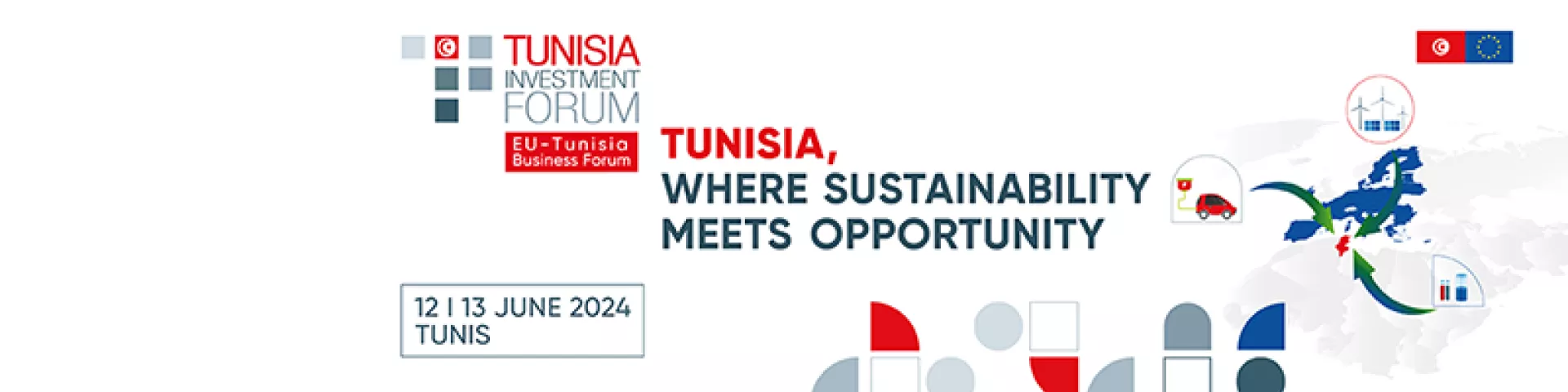
An EU-Tunisia investment conference, jointly organised by the EU and the Foreign Investment Promotion Agency (FIPA) of Tunisia, also took place in Tunis on 12-13 June 2024. It allowed Tunisian and European private sector actors to exchange and Tunisia to showcase its reform efforts in terms of investment and business climate. It was also the occasion for the EU and Tunisia to sign the EU-Tunisia Energy MoU as well as to launch three projects on road transport connectivity (with the European Investment Bank), on SME support (with the EIB and the French Development Agency) and on energy infrastructure (with the EIB, the German Investment Bank and the European Bank for Reconstruction and Development). The EU, together with participating Member States and the EU financing institutions, also launched the Team Europe Initiative on investments in Tunisia.
Cooperation
Through all its instruments, the EU has been supporting democratic and socio-economic reforms, accompanying the electoral processes, promoting human rights, strengthening civil society actors, enhancing economic and trade integration, improving security and addressing migration.
Since 2011, EU assistance to Tunisia has amounted to €3.4 billion with over €2 billion in grants and €1.4 billion in macro-financial assistance (concessional loans).
EU assistance to Tunisia is currently funded mainly through the Neighbourhood, Development and International Cooperation Instrument-Global Europe (NDICI-GE) for the period 2021-2027. Under NDICI-GE, bilateral assistance is adopted on an annual basis through individual measures, in line with the current EU-Tunisia Strategic Priorities. For the period 2021-2024, the EU’s bilateral assistance to Tunisia under NDICI amounts to €620 million.
The Joint Communication on the renewed partnership with the Southern Neighbourhood is accompanied by an Economic and Investment Plan for the Southern Neighbours to ensure amongst others that the quality of life for people in the region improves and the economic recovery, including following the COVID-19 pandemic, leaves no one behind. The Plan includes 12 preliminary flagship initiatives to strengthen resilience, build prosperity and increase trade and investment to support competitiveness and inclusive growth. Relevant flagships for Tunisia include: (1) support to the conclusion of a Comprehensive Air Transport Agreement with the EU, (2) support to the deployment of social protection systems improving the resilience of vulnerable populations, (3) support to the digitalisation of the economy, (4) support to the rollout of the national water strategy, securing availability and access to water.
Under the NDICI-GE instrument, an increased accent on blending EU grants with loans from European and International Financing Institutions will allow partner countries to unlock a substantial level of concessional funding for investments. EU grants increase the concessional nature of loans from European Financial Institutions and absorb political and economic risks.
The new system of guarantees provided for under the NDICI-GE will give access to additional funds from the crowding-in of both public and private investors. In the framework of the Economic and Investment Plan, over €728 million in grants have been mobilised by the Commission since 2021 for Tunisia under the European Fund for Sustainable Development Plus which are expected to mobilise over EUR 6 billion in investments for programmes on education, water, renewable energy, food security, transport and access to finance for SME. A few examples of projects:
- The improvement of the learning and teaching conditions in schools thanks to the signature in December 2023 of a €25 million grant to leverage an EIB loan of €40 million for a programme worth €65 million, to support 14,500 pupils in primary education with 80 new primary schools and new school transport, and improved digitalization in schools.
- The support to the “ELMED” electricity interconnection project between Tunisia and Italy to boost renewable electricity production in Tunisia and its future export to Europe, with the signature of a €306.7 million grant agreement under the Connecting Europe Facility in August 2023, and the adoption of a €27 million grant in December 2023, to leverage €125 million in loans from the EIB, EBRD and KfW to support the reinforcement of the policy dialogue in the energy sector, and the creation of a new national electricity dispatch centre. The total support of EU and international donors for this project amounts to €1.2 billion.
- The reinforced support to food security with the signature in December 2023 of a €20 million grant to leverage a €150 million loan from the EIB to support the grain purchase, the modernisation of grain storage and transport infrastructure, and the reform of the agricultural sector’s national management. This project is part of an overall programme worth €570 million implemented with other European and international donors (EBRD, World Bank, African Development Bank), in response to Tunisia’s food security crisis generated by Russia’s aggression war against Ukraine since 2022.
In addition to bilateral cooperation, Tunisia is benefiting from regional cooperation programmes under the NDICI-GE since 2021, and previously under the European Neighbourhood Instrument (2014-2020), in the sectors of economic development and business environment; education, training and research; culture and media; migration and asylum; justice, freedom and security; environment, climate change and energy; civil society.
Support in the field of migration
Tunisia benefits from bilateral and regional migration-related funding under the NDICI-GE and under the Asylum, Migration and Integration Fund, and previously in 2017-2020 under the North of Africa window of the European Union Emergency Trust Fund for stability and addressing root causes of irregular migration and displaced persons in Africa, for a total of around €200 million of ongoing programmes. The EU and Tunisia cooperate on all aspects of migration in a holistic approach comprising migration governance, border management, protection, fighting smuggling and trafficking, labour migration and legal mobility, diaspora mobilisation, return, readmission and reintegration. In 2023, Tunisia will benefit from an indicative amount of €105 million migration-related funding under NDICI-GE.
Other cooperation tools between the EU and Tunisia
Tunisia also benefits from the following thematic EU programmes and instruments:
- Erasmus+: Since 2021, 1329 Tunisian students and staff travelled to Europe and 476 European students and staff travelled to Tunisia through Erasmus+. Additionally, 28 Tunisian students benefitted of Erasmus Mundus grants in 2021 and 2022 to conduct Masters’ degrees in Europe. This adds up to the mobility offered by the previous 2015-2020 Erasmus+ programme where 2,877 Tunisian students and staff travelled to Europe and 1,208 European counterparts travelled to Tunisia.
- Horizon Europe: Since January 2021, Tunisia takes part in Horizon Europe for the 2021-2027 period as associated country. It follows the EU research programme Horizon 2020 to which Tunisia was the first and only one associated Arab and African country in January 2016. Tunisia is the best performing Maghreb country in the programme. The priority areas in the Horizon Europe budget going to Tunisia are Widening participation and spreading excellence, Food, Bioeconomy, Natural Resources, Agriculture and Environment. Examples of ongoing projects funded by Horizon Europe with Tunisian beneficiaries include NATAE, LoCEL-H2 and DigiMedFor.
- Creative Europe: Tunisia participates in the Creative Europe Programme since 2017. Tunisian cultural and creative organisations participate fully in the culture strand of the programme. A Creative Europe Desk has been established in Tunisia to provide guidance on the opportunities offered by the programme to local organisations.
- Cross-border cooperation: Tunisia benefits in 2021-2027 of the Interreg NEXT Italy-Tunisia (particularly focused on the Green Deal, with 45% of the programme funding allocated to green transition measures, as well as on investments in SMEs and entrepreneurship, cross-border business networks; sustainable tourism; better cooperation governance as well as equal and better access to health systems €32.3 million EU funding) and the Interreg NEXT MED programmes (brings together 15 Mediterranean countries including Tunisia and finances joint cooperation projects that aim to make the Mediterranean a greener, cleaner, more competitive and more inclusive space to live; €263 million EU funding).
- Foreign Policy Instrument: €6 million in 2023-2024 for actions focusing on counter terrorism – e.g. Tunisia's participation in the EU Global Facility on Anti-Money Laundering and Countering the Financing of Terrorism (GF-AML/CFT) – and the prevention of radicalization. Tunisia is also involved in several FPI-led transregional projects on combating organised crime and improving capabilities to protect against Chemical, Biological, Radiological and Nuclear events.
- NDICI-GE Human Rights and Democracy / Civil Society Organisations thematic lines: Since beginning 2023, four projects are being implemented under the Human Rights and Democracy thematic programme for around €3.3 million on protection of activists, and fighting against sexual, religious, ethnic discrimination, elections, and institutional violence. Early 2024 three new projects on civil society sustainability, economic services and citizen participation for €2.7 million have been launched. These projects complement bilateral support to civil society, which the EU has been giving even greater importance since 2011 in the Southern Neighbourhood. In 2022, a new common EU roadmap for the work with civil society in Tunisia was launched based on the successful long-term tripartite dialogue and on country-wide consultations with civil society organisations and Member States.
- Twinning: The Tunisian public administration is partnering with European administrations for mutual learning and capacity building through sharing of EU best practices. There are three ongoing twinning programmes in the sectors of the governance of the retirement system, the promotion of the auto-entrepreneurship regime and the national veterinary framework for animal health.
- TAIEX: Tunisia benefited from TAIEX (Technical Assistance and Information Exchange instrument) that supports public administration reforms with 74 national events and 44 multi-country events to which Tunisia participated in 2018-2023.

ENI 2015/C(2015)5527/Annual Action programme for Tunisia (Part 1)
- ENI 2015/038411/Tunisia/Regional Initiative for sustainable economic development (IRADA)
- ENI 2015/038406/Tunisia/Security Sector Reform
- ENI 2015/038415/Tunisia/Support for the cultural sector
- ENI 2015/038422/Tunisia/Decentralisation (CAP 2D)
- ENI 2015/038409/Tunisia/Association Agreement and Integration (P3AI)
ENI 2016/C(2015)9065/Annual Action Programme for Tunisia (Part 2)
ENI 2014/C(2014)7273/Annual Action Programme for Tunisia
- ENI 2014/037535/Tunisia/Border Management and International protection
- ENI 2014/037533/Tunisia/Programme for Economic recovery IV (PAR IV)
- ENI 2014/037342/Tunisia/Justice Reform 2 (PARJ 2)
- ENI 2014/037337/Tunisia/Support to Media
- ENI 2014/037336/Tunisia/Promotion of Gender-Equality
- ENI 2014 /037346/Tunisia/Rehabilitation of Districts: extension phase
- ENI 2014/037345/Tunisia/Support of Association Agreement and Transition (P3AT3)
ENPI 2012/C(2012)5582/Annual Action Programme for Tunisia (Part 1)
ENPI 2012/C(2012)8640/Annual Action Programme for Tunisia (Part 2)
ENPI 2012/C(2012)6858/Support to the Justice sector under SPRING Programme
ENPI 2012/C(2012)8833/P3AT2 under SPRING Programme
ENPI 2012/C(2012)9278/Approving Integration of Districts programme